
Governance at a Crossroads: Lessons from the ICGN Korea Conference 2026
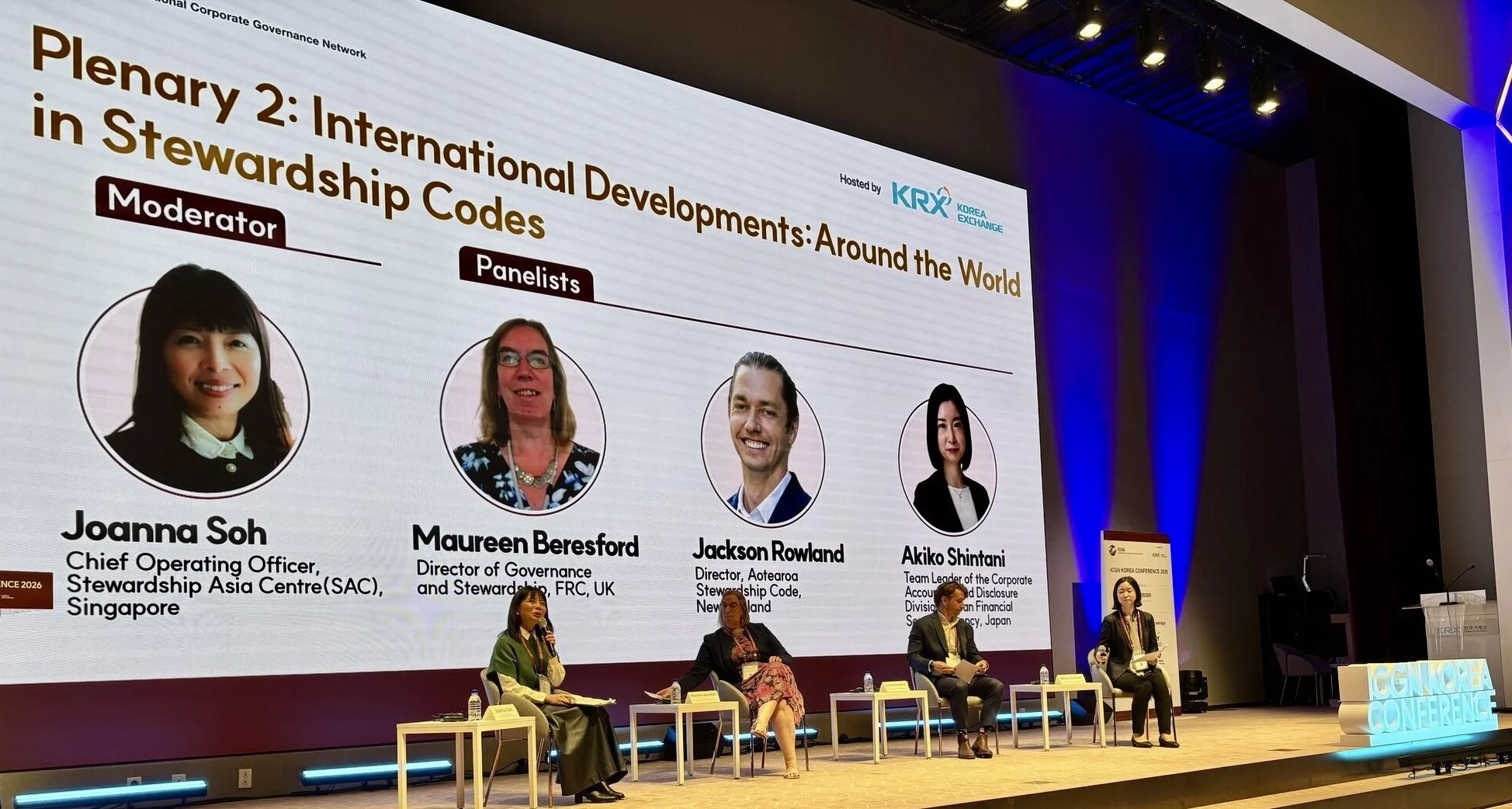
In April 2026, the Aotearoa New Zealand Stewardship Code was invited to speak at the ICGN Korea Conference in Seoul — one of the most significant gatherings in the global corporate governance calendar. Code Director, Jackson Rowland, attended as the Code's representative and the only New Zealander at the conference, joining a programme that included a keynote from Jen Sisson, CEO of the International Corporate Governance Network (ICGN), and featured a panel on the evolution of stewardship codes around the world.
GOVERNANCE IS A PARTNERSHIP
Jen Sisson opened by reframing how we think about corporate governance. Investors, boards, and management are on the same team — all want thriving companies delivering sustainable long-term returns. Governance, in this framing, is not adversarial; it is a partnership that builds resilience into companies, enabling them to anticipate challenges rather than react to them. Boards set the tone and provide accountability, but even the most effective board can only operate well if the framework around it upholds high standards.
THE WEIGHT OF OWNERSHIP IS GROWING
A striking statistic anchored the conversation: institutional investors now hold 47% of global listed equity. As that proportion grows, so too do the obligations that come with it — not just to provide capital, but to act as responsible, active owners. Jen also flagged the fixed income gap: corporate bond issuance has grown 57% over the past decade, yet disclosure frameworks remain disproportionately equity-focused. That imbalance needs to change.
THE GLOBAL DIRECTION IS TOWARD OUTCOMES
The clearest thread running through Jen's address was a shift in what the world expects from governance. Regulators, asset managers, and market participants are moving away from process compliance and toward demonstrable outcomes — what is material, what is decision-useful, and what genuinely strengthens accountability and long-term value creation. The question is no longer whether governance frameworks exist, but whether they are working.
NAVIGATING A FRAGMENTING LANDSCAPE
At the same time, the global governance environment is becoming more fragmented. Some jurisdictions are deepening their frameworks; others are pulling back. Investors must increasingly navigate markets with diverging expectations — a new and complex challenge that demands both local knowledge and global perspective.
CREDIBILITY IS WHAT MATTERS
In uncertain times, Jen argued, credibility is the foundation. Boards, regulators, and investors alike must demonstrate discipline — knowing when to engage, when to escalate, and how to exercise stewardship with genuine conviction. Markets are rewarding transparency and accountability. Governance will not eliminate uncertainty, but it provides the foundation on which resilient, long-term markets are built.
STEWARDSHIP CODES AROUND THE WORLD
Jackson joined a panel exploring how stewardship frameworks are evolving globally, alongside Maureen Beresford from the UK's Financial Reporting Council and Akiko Shintani from Japan's Financial Services Agency — the organisations behind two of the most influential and long-established stewardship codes in the world. The invitation to speak in that company reflects the growing international recognition of the Aotearoa Code as a leading framework. The discussion explored a common theme: codes are maturing, and the bar for what effective stewardship looks like is rising. Company-level engagement alone is no longer enough — investors are increasingly expected to engage at the system level, working with regulators and industry to address the risks that will define long-term value.
Jackson spoke to the New Zealand experience: the rapid growth in stewardship practice since the Code's launch in 2022, the particular dynamics of a small, relationship-based market, and the resonance of Te Ao Māori with long-term institutional investors whose mandates already span generations.
KOREA: REFORM IN FOCUS
Korea was a fitting host for this conversation. It was the world's best performing stock market in 2025, and corporate governance reform has been central to that story. The Korean market has historically been shaped by concentrated ownership, with a small number of controlling shareholders exercising significant influence over major listed companies — and limited stewardship in the broader sense. Larger minority investors have been more active, but their influence has been constrained by structural realities. Reforms now underway — aimed at improving minority shareholder protections, enhancing disclosure, and strengthening accountability — are beginning to shift that dynamic, and the international governance community is watching closely.
THE TAKEAWAY
From Seoul to Wellington, the message from ICGN 2026 was clear: governance is not a compliance exercise. Done well, it is a discipline that connects ownership to outcomes — for investors, for companies, and for the markets we all depend on. The direction of travel is encouraging. The work continues.